I held his gaze, smiled without saying a word, packed a small bag that same night, and left without saying goodbye. Seven days later, his phone rang…
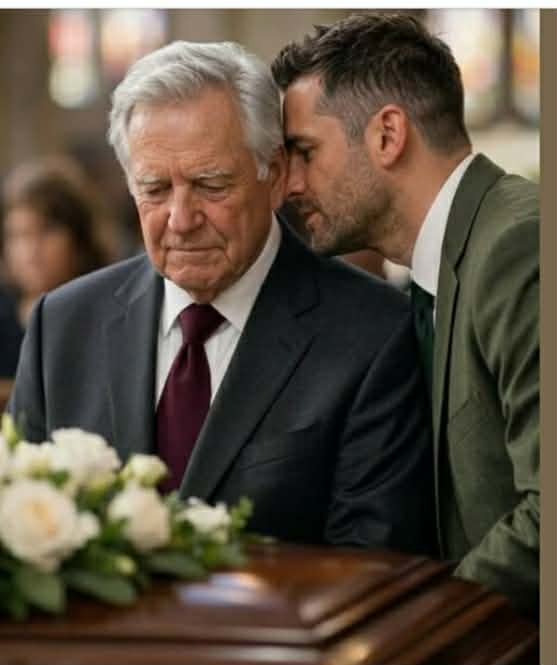
The funeral of my daughter, Laura, was the darkest day of my life.
The church was filled—colleagues, neighbors, distant relatives, and strangers I barely knew—all gathered to mourn her. White and pale pink flowers crowded the altar, their sweet scent heavy in the warm air. Candles trembled in tall brass holders, casting an uncertain light on the ancient stone walls. Somewhere in the background, the organ played a slow funeral hymn I had heard too many times before.
And yet, in the midst of all those people, I had never felt so alone.
I stood a short distance from the closed coffin, my hands hanging uselessly at my sides. I stared at the polished wood as if, by looking hard enough, I might somehow make it open—hear her voice one last time. Just once. Long enough for her to tell me, “Dad, it’s okay. I’m fine. There’s been a mistake.”
But coffins don’t make mistakes, and death does not negotiate.
Laura had been my whole world. She was the reason I kept going after everything else had fallen apart. When her mother died, the house became an empty shell. Every room echoed. The bed felt too wide, too cold. That first night, I watched my little girl cry herself to sleep, her small shoulders trembling under the blanket, and I made a silent promise—to her, and to whatever force might be listening—that I would protect her, no matter the cost.
And I did.
I raised her alone. At first clumsily, then with the fierce devotion only a widowed father truly understands. I worked two jobs, sometimes three, to give her every opportunity. I learned to braid hair badly, ruined more dinners than I can count, and stayed up late helping with homework I barely understood. The day she got into university, I cried alone in the kitchen. The day she graduated, I clapped until my hands hurt and shouted her name until my throat burned.
I was there for every milestone in her life.
And I was there the day she introduced me to Daniel.
Even beside her coffin, the thought of him crept into my mind and tightened my throat with grief and resentment. Daniel stood near the front pew in a perfect black suit, every hair in place, his face arranged in an expression of noble suffering. People kept approaching him, touching his sleeve, shaking his hand, whispering condolences as if he were the one who had suffered the greatest loss.
He played his role flawlessly.
From time to time, some of the older women would glance at me, remember I was Laura’s father, then drift back toward Daniel, drawn in by the elegance of his sorrow. I watched the quiet theatre of it all—the bowed heads, the sympathetic looks, the soft voices saying, “So tragic,” “She was too young”—and something inside me recoiled.
Not because grief can be measured, but because I knew exactly what lay behind his controlled façade.
Throughout the service, Daniel barely acknowledged me. His gaze passed over me as if I were just another object in the room. The few times our eyes met, there was no warmth. If anything, his expression hardened, as if my presence bothered him even on the day we buried Laura.
The priest spoke of faith, eternal peace, and Laura having “gone home.” I heard only fragments. My mind drifted through memories—her first bicycle, the day she broke her arm falling from a tree, the long stormy night we stayed awake because thunder frightened her. When the priest sprinkled holy water over the coffin and the drops rolled down the wood, it felt like watching what remained of my life wash away.
When the ceremony ended, people slowly began to leave. Some stopped to grip my shoulder and offer the usual words—“Stay strong,” “Call if you need anything,” “She’s in a better place.” I nodded without truly hearing them.
Then I saw Daniel near the doors, accepting one last round of condolences.
And then he came toward me.
He walked with quiet precision, his face expressionless, like a man who had already decided what to say.
“Antonio,” he said softly.
It was the first time he had spoken directly to me that day.
“We need to talk.”
There was no warmth in his voice. No shared grief. No acknowledgment of what we had both lost. It was the voice of someone handling a practical matter. Still, I followed him—I was too exhausted to do otherwise.
We stepped aside near an old wooden confessional. Colored light from the stained glass fell across the floor. For a moment, I thought he might say something decent.
Instead, he said the words I will never forget.
“You have twenty-four hours to leave my house.”
The sentence did not explode. It landed with the cold finality of a judge’s ruling.
His voice never rose. There was no anger—only calm, efficient command, delivered on the day we buried my daughter. His eyes remained steady, detached. He spoke like a man closing a transaction.
Something twisted sharply in my chest. Not shock—Daniel had always been like this: controlled, calculated, deliberate. But even knowing who he was, part of me could not believe he chose that moment to throw me out.
“The house is legally mine,” he continued. “I need space. I can’t deal with complications. It’s not good for me—or for moving on.”
He spoke without hesitation, without apology.
I looked at him carefully: the expensive suit, the polished shoes, the watch worth more than my car. The carefully measured expression meant to show just enough pain to gain sympathy. I remembered dinners at that house—Laura laughing, trying to ease the tension between us.
A knot tightened in my chest. Maybe anger. Maybe grief turning colder.
But I didn’t shout.
I smiled.
Just a small smile. Not mocking. Not challenging. Just for myself—a quiet reminder that I still had control over something.
“I understand,” I said softly.
I didn’t argue. I didn’t remind him of anything. I simply nodded.
That evening, I returned to the house for the last time.
Without Laura, it felt hollow. When I passed her room, the door was slightly open. I stopped, looking at her bed, untouched. I could almost hear her voice.
I stepped inside and stood in silence. Her scent still lingered faintly in the air. On the desk was a wedding photo of her and Daniel. On the nightstand, a smaller photo—Laura as a child on my shoulders at the beach.
I packed only the essentials that night. Clothes, documents, and that old photograph. I made the bed out of habit. I left the keys on the table.
At the door, I looked around one last time.
“Goodbye, hija,” I whispered. “I hope you don’t see this part.”
Then I left.
That night, I stayed in a small hostel near the train station. Daniel believed he had won.
What he didn’t know was that I had been a silent partner in his company from the very beginning.
Sleep came in fragments. Grief does not rest easily.
The next morning, I called my lawyer.
“Antonio,” he said, “I was just about to call you. I’m very sorry about Laura.”
“Thank you.”
“I need you to review the company structure,” I said quietly. “And remind Daniel of a few things he seems to have forgotten.”
Seven days later, while I sat in a café, Daniel received a phone call.
And everything changed.
The law firm told him:
“Mr. Martínez, according to company records, Mr. Antonio García owns eighty-four percent of the business.”
Silence.
Then panic.
Because he finally understood: the quiet man he dismissed… was the one who held the real power.
Later, he called me.
We met in a small office.
“I’m not here to destroy you,” I told him.
“I want respect. For Laura. For what was built.”
He thought I would seek revenge.
But I chose something else.
A chance for him to change.
And in the months that followed, the company changed too.
And so did he—slowly.
I never got my daughter back.
But I found something else.
Purpose.
And in that purpose, I kept her memory alive.
Not just in stone.
But in life.